
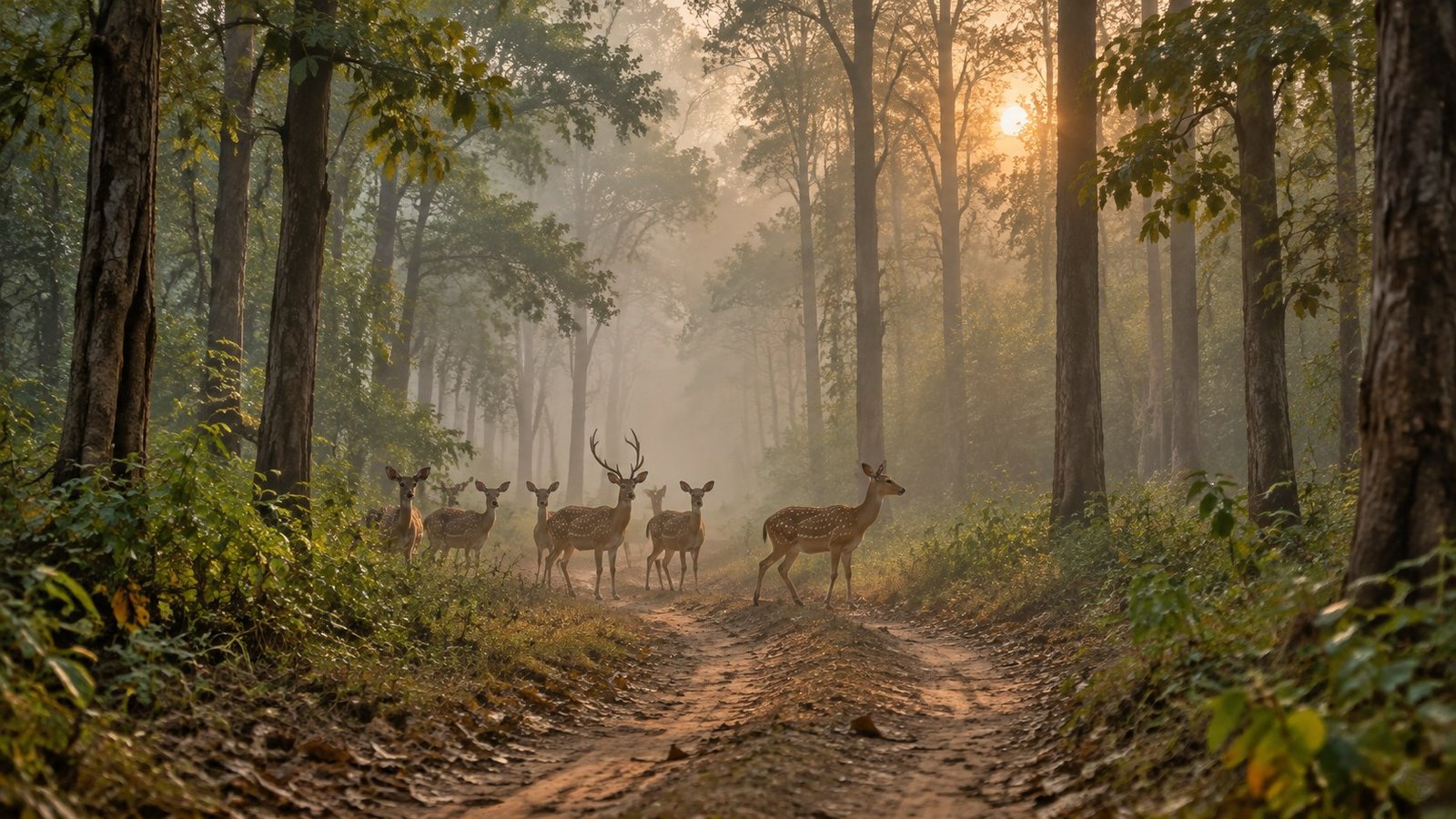
Most people arrive at Bandipur or Kabini with a good camera, a lot of hope, and one habit that works against them. They watch the forest only through the viewfinder. They scan for stripes and spots, and they miss the conversation happening all around the jeep.
Here is what a decade in these forests has taught me. The forest almost always tells you what is happening before it shows you. A langur on a high branch, a spotted deer frozen mid-step, a line of fresh pugmarks crossing the track. If you learn to read these signs, you stop chasing sightings and start anticipating them. Your photography changes completely.
This guide is the field craft I teach on every Katrivia expedition. No gadgets, no shortcuts. Just attention.
The Forest Announces Its News
An alarm call is not background noise. It is information, and the animals of the Indian forest are remarkably specific about what they are saying.
The langur on watch
Grey langurs sit high in the canopy and see further than anything on the ground. When a langur gives a series of deep, repeated barks from one fixed position, it has usually spotted a predator moving below. The key details are direction and duration. A langur that calls while looking steadily into one patch of forest is telling you where the cat is moving. When the calling stops and the troop goes quiet, the animal has often settled or moved out of sight, and the story has moved on.
Chital, the most honest voice in the forest
Spotted deer are the alarm system most guides trust the most. A chital alarm is sharp, high, and repeated, and it is almost always about a predator. One or two calls can mean uncertainty. A sustained burst, with several deer calling in the same direction and stamping, means the predator is there and moving. When I hear chital calling steadily, I stop thinking about anything else and start watching the tree line or the grass edge they are facing.
Sambar and peafowl
Sambar deer give a loud, ringing bark that carries far. They are big, cautious animals, and a sambar alarm often means the predator is close and confident. Peafowl add their own harsh calls to a sighting, and jungle fowl will sometimes scold a leopard walking through their patch. When two or three species are calling at once and pointing the same way, you can be fairly sure something is on the move.
Reading Tracks and Signs on the Track
Alarm calls tell you what is happening now. Tracks and signs tell you what happened while you were away, and that story shapes the rest of your drive.
Pugmarks on the dust
Fresh pugmarks on a safari track are worth slowing down for. Look at the direction of travel first, then the freshness. Sharp edges, clear pads, and dust not yet blown across the print tell you the animal passed recently. Big, broad pugs without visible claw marks belong to a cat. On our drives in Nagarahole, we often read a set of pugmarks, work out which direction the animal was walking, and quietly plan the next stretch of track around that.
Scat, scrapes and scent marks
Leopards and tigers leave scrape marks on the road, claw rakes on tree trunks, and scat in visible spots. These are territory signals, and they tell you which animals use which routes regularly. Elephant herds leave broken branches, dung, and rub marks on trees. Gaur leave deep, split-hoofed prints near water and grazing meadows. None of this guarantees a sighting. All of it tells you where to slow down, be quiet, and keep the camera ready.
Water and salt licks
In the drier months, water bodies concentrate activity. Tracks converging on a waterhole, fresh dung, and nervous behaviour from deer near the bank are all signs worth reading. In places like the Kabini backwaters, the receding water line becomes a stage where the whole cast eventually appears.
Turning Signs into Photographs
Reading the forest only matters if it changes what you do with the camera. Here is how I convert a sign into a frame.
Position before the moment
When alarm calls point into a patch of cover, I think about where the animal is likely to emerge, not where it is now. A track crossing, a gap in the lantana, a game trail leading to water. I set my exposure for that gap and wait. The photographers who get the clean walking shot are rarely lucky. They were aimed at the right gap two minutes before the cat stepped into it.
Read the light with the sign
A sign tells you where to look. The light tells you whether the photograph will work. If the likely emergence point is in deep shade against bright sky, the frame will struggle no matter how good the sighting is. Sometimes the right call is to wait for the animal to move into workable light, and sometimes the right call is to enjoy the sighting and keep the shutter quiet.
Patience is a field skill
The hardest lesson for new photographers is that a strong sign often means waiting, not shooting. When we position the jeep on a fresh set of calls, we might sit for a long stretch with nothing in the frame. Then the forest exhales and everything happens at once. The people who kept their settings ready and their hands steady make the image. The ones who got bored and started reviewing old photos miss it.
Ethics Come Before the Image
Reading the forest is a privilege, and it comes with rules that are not negotiable on our expeditions.
We never call out to animals, mimic calls, or use sounds to draw attention. We never ask the driver to block an animal’s path or push closer than the animal is comfortable with. We stay seated, stay quiet, and follow the forest department rules and the naturalist’s instructions at all times. A stressed animal gives you a poor photograph anyway. A relaxed animal, photographed at a respectful distance, gives you behaviour, and behaviour is what separates a record shot from a portfolio image.
Learn It Where It Happens
You can read about alarm calls in a book, but the first time you hear a chital burst build through a valley and then watch a leopard walk out exactly where the deer said it would, something clicks permanently. That is why we teach this in the field, on real drives, in Bandipur, Kabini, Nagarahole, and Bhadra.
I am Arvind Karthik, founder of Katrivia Expeditions. My own journey in the forest began in 2014, and I have been a professional wildlife photographer since 2019. On our photo tours and field workshops, we spend as much time learning to read the forest as we do on camera settings, because the forest is where every great frame actually begins.
If you want to learn field craft hands-on, join us on an upcoming expedition. Call or WhatsApp us on +91 96208 08727 and we will help you pick the right forest and the right season for your first, or your fiftieth, safari.
FAQs
What is an alarm call on safari?
An alarm call is a sound an animal makes when it spots a predator. Langurs, spotted deer, sambar, and peafowl all have distinct alarm calls, and experienced guides use them to locate tigers and leopards. For a photographer, alarm calls are advance notice of where action is likely to unfold.
How do I learn to identify animal tracks in India?
Start with the common ones: cat pugmarks, deer and antelope hooves, elephant and gaur prints. Photograph tracks you see on drives and compare them later with a field guide or your naturalist. The fastest way to learn is on guided drives where the naturalist reads the track with you in real time.
Can reading signs guarantee a tiger or leopard sighting?
No, and be careful of anyone who promises one. Signs improve your odds and your positioning, but wildlife is wild. The real benefit is that you spend your drive understanding the forest instead of randomly scanning it, and your photography improves whether or not a cat appears.
Which parks are best for learning field craft in South India?
Bandipur, Kabini (Nagarahole), and Bhadra are excellent learning grounds because they have healthy prey populations, active predator movement, and varied habitat. Each forest has its own rhythm, and reading several of them makes you a far better naturalist and photographer.
Do I need an expensive camera to benefit from field craft?
Not at all. Field craft is about where you point the camera and when, not what the camera costs. A photographer with a basic telephoto who reads the forest well will outshoot an unprepared photographer with top-tier gear on most drives.
Is it safe to track animals from a safari jeep?
Yes, when done correctly. You stay inside the registered vehicle, on designated tracks, with a trained driver and naturalist. The reading happens with your eyes and ears. Nobody leaves the vehicle, and nobody approaches wildlife on foot inside a tiger reserve.