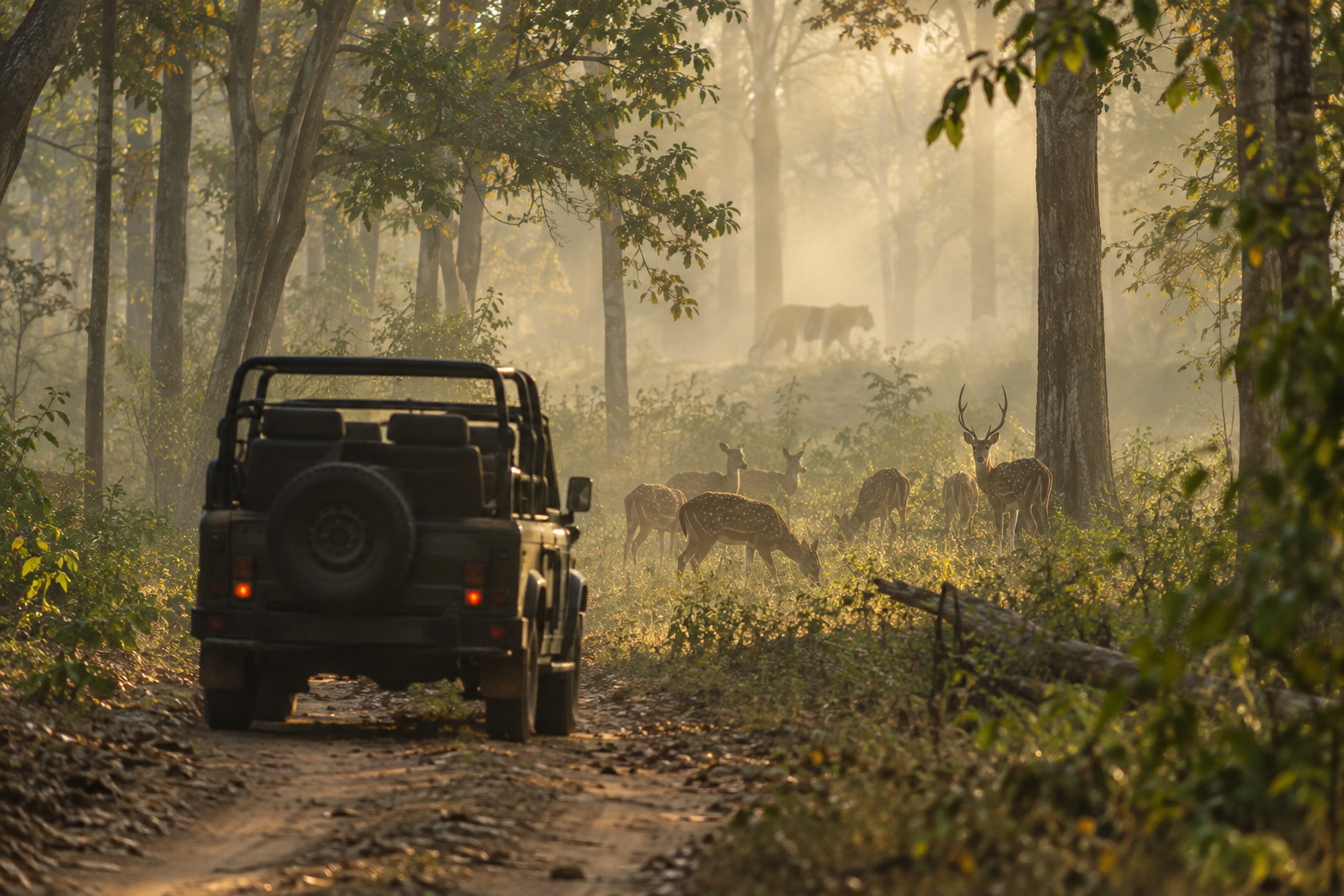
On almost every safari, the same small scene plays out. The jeep slows, a herd of chital looks up from the grass, and three cameras come alive at once. One photographer stands up on the seat and wobbles. Another fights a tripod that has no room to open its legs. A third is still changing lenses while the moment passes in front of all of them.
The vehicle feels like the enemy when you start out. It is high, it vibrates, other people move inside it, and the driver never seems to stop exactly where you want. Every photographer who spends enough seasons in Bandipur, Kabini, Nagarahole, and Bhadra learns the same lesson: the vehicle is not the problem. Untrained habits are. Once you learn to work with the vehicle instead of against it, it becomes the best hide you will ever photograph from.
These vehicle field-craft tips can help you prepare for your next safari. None of them needs new gear. All of them need attention.
The Vehicle Is Your Hide, Not Your Problem
A safari jeep does something no photographer on foot can do in a tiger reserve. It makes you part of a shape the animals already know. Deer, elephants, and even big cats read the jeep as one large, familiar object that follows the track and keeps a predictable distance. They tolerate it at ranges they would never tolerate a walking human.
That tolerance is your opportunity, and it has one condition: you must stay inside the shape. The moment an arm hangs far out, a lens points from an unexpected angle, or someone stands and breaks the vehicle’s outline, the animal reads you separately. Ears come up. The relaxed behaviour you came to photograph ends. Every habit in this guide exists to protect that one advantage.
Set Up Before the Sighting
Most missed shots on safari are lost five minutes before the animal appears. The photographers who come home with the frame are the ones who were already ready.
Choose your seat deliberately
In an open jeep, every seat photographs differently. The middle rows give you a stable, roughly eye-level view on both sides of the track. The rear row shoots well over the back for animals following the vehicle, but it vibrates the most. The front seat beside the driver sits low and gives a beautiful low angle, at the cost of shooting mostly forward. A simple habit worth building with any group is rotating seats between drives so everyone works every angle. Knowing your seat’s strengths before the sighting removes the panic during it.
Stage your camera for the forest, not the parking lot
Set a starting exposure for the habitat before the vehicle even leaves the gate. In the dry deciduous forest of Bandipur, that usually means preparing for patchy light under canopy, with a shutter speed fast enough to freeze a walking animal and an aperture that keeps a single subject sharp. When the cat steps out, I am adjusting from a working baseline, not building settings from zero. Review your last trip’s frames at home, decide your starting points, and load them before the drive begins.
One lens on, one lens reachable
Changing lenses inside a dusty, moving jeep is how sensors get dirty and moments get missed. Ride with your primary telephoto mounted and a shorter lens in a padded bag within arm’s reach, caps loose. If a tusker walks close enough that the telephoto cannot fit him in, I can switch in seconds because everything was staged for exactly that surprise.
Stability on a Moving Platform
Camera shake on safari rarely comes from your hands. It comes from the vehicle: the engine idling, the floorboards flexing, the person beside you shifting weight. Good stability technique is mostly about isolating yourself from all three.
The bean bag is the jeep photographer’s best friend
A well-filled bean bag over the window frame or the vehicle’s front rail absorbs vibration and gives you a panning surface that moves as smoothly as your body does. Rest the lens barrel on it, not the camera body, and keep a light downward pressure through your left hand. With a bean bag doing its job, sharp frames are possible at shutter speeds no one should attempt hand-held. A tripod, by contrast, almost never earns its space inside a shared jeep.
Brace with your body, not your arms
When the bean bag cannot reach the angle, brace your elbows against your ribcage, tuck your shoulders, and lean your back into the seat frame so your torso moves with the vehicle as one unit. Never brace against a part that vibrates independently, like a loose door panel. Breathe out gently and press the shutter at the bottom of the breath, the same discipline a rifle instructor would teach.
Engine off is a non-negotiable
An idling engine puts a fine tremor through the whole vehicle that you cannot see but your lens magnifies brutally. Whenever the vehicle stops for a sighting, the first quiet word to the driver should always be the same: engine off. Frames sharpen instantly. As a bonus, the forest relaxes, and the behaviour in front of you improves. If your driver keeps the engine running through a sighting, ask politely and explain why. Good drivers appreciate a photographer who knows what they need.
Angles from a Rolling Platform
You cannot walk around your subject on safari, so composition becomes a game of small adjustments: a slight lean, a lower window, a request for the vehicle to roll forward two feet. Learn to see those options before you raise the camera.
Shoot across the jeep, not around it. The cleanest frames usually come from photographing the side of the track your seat naturally faces, rather than contorting across your neighbour. Work the background as hard as the subject: a two-foot shift in vehicle position can move a distracting tree trunk out from behind a leopard’s head. And when the animal is close and the light allows, drop low. Shooting from the footwell edge or the lowest window gives an intimate, eye-level frame that separates safari photographers from safari tourists.
Working with Your Driver and Naturalist
On a good safari, the driver and naturalist are half of your camera system. They control position, angle, light, and timing. Treat them as collaborators and your photography will improve more than any lens upgrade could manage.
Agree on quiet hand signals before the first drive: slower, stop, engine off, roll forward slightly, reverse slightly. Speak in whispers and keep requests small and specific. Most of all, tell them what you are trying to photograph, not just where to stop. When the driver knows you are waiting for a head-turn toward the light, they can position the vehicle so the frame is possible instead of merely the sighting. Never pressure a driver to close distance or block an animal’s path for a photograph. The best naturalists refuse, and that refusal protects both the wildlife and the quality of what you bring home.
Light, Dust and Movement
A vehicle adds two gifts and one curse to your light. The gifts are height and mobility: you sit above the grass line, and the vehicle can reposition when the light is wrong. The curse is dust, your own and every other vehicle’s, hanging in the air between you and the subject.
Learn to use dust instead of fighting it. Backlit dust on a winter morning in Kabini turns an ordinary deer herd into theatre, with every hoof-strike lit from behind. When another jeep raises a wall of dust in your line, do not spray frames through it. Wait, reposition, or lift the composition into the light shafts. For moving subjects, pan with your whole torso from the waist, follow through after the shutter, and let the bean bag carry the lens. A walking tiger photographed with a smooth pan at a moderate shutter speed has life in it. The same frame made in a hurry has none.
Ethics from the Vehicle
Everything above sits on top of responsible safari conduct, the habits every thoughtful vehicle crew should follow. Stay seated. Keep every part of your body and gear inside the vehicle’s outline. No calls, no sounds, no tapping to make an animal look up. Follow the forest department’s rules and the naturalist’s instructions at all times, and keep the silence that lets everyone, including the wildlife, have a better day.
Remember that a calm animal gives you behaviour, and behaviour is what separates a record shot from a portfolio image. A tiger that walks calmly past a quiet, well-mannered vehicle gives every photographer on it a better frame than a stressed tiger ever will.
The Mistakes I See Every Season
Reviewing the LCD after every frame is the most expensive habit on safari. The head-turn you wanted happens while you are looking down. Chimping has its place, and it is the quiet stretch after the sighting, not during it. The second mistake is carrying a lens that is too long for the forest and refusing to zoom out; a tight frame of half a leopard is worth less than a full environmental frame of the same animal in its habitat. The third is talking through sightings. Sound travels further than you think, and the photographers who whisper are the ones whose frames keep happening.
Learn It Where It Happens
You can read about vehicle craft at home, but the first time a driver kills the engine on your whispered signal, the forest goes still, and a leopard walks across the gap you had already framed, something clicks permanently. That is why this craft is best learned in the field, on real drives, in Bandipur, Kabini, Nagarahole, and Bhadra.
I am Arvind Karthik, founder of Katrivia Expeditions. My own journey in the forest began in 2014, and I have been a professional wildlife photographer since 2019. On our photo tours and field workshops, you can put this craft into practice on real drives, because the jeep is where every safari photograph actually begins.
If you want to learn field craft hands-on, join us on an upcoming expedition. Call or WhatsApp us on +91 96208 08727 and we will help you pick the right forest and the right season for your first, or your fiftieth, safari.
FAQs
Can I use a tripod inside a safari jeep?
In most shared safari vehicles, a full tripod is impractical because there is no floor space to spread the legs safely, and it slows you down when the action moves. A bean bag on the window frame or rail, combined with good bracing technique, is far more effective inside a jeep. Some photographers carry a monopod, which works when you have a dedicated seat and room beside you.
What camera settings should I start with on safari?
Start with a shutter speed fast enough to freeze a walking animal, an aperture that keeps a single subject sharp while softening the background, and auto ISO to bridge the two as forest light changes. Set this baseline before the drive begins, then adjust from it as conditions shift. Your naturalist and guide can help you read the light for each habitat you enter.
Is it safe to photograph wildlife from a vehicle?
Yes, when you follow the rules. Stay seated, keep arms and equipment inside the vehicle, remain quiet, and follow your naturalist’s instructions at all times. Inside India’s tiger reserves, visitors remain in registered vehicles on designated tracks, and nobody approaches wildlife on foot. The vehicle is your safety boundary as well as your hide.
Which seat in a safari jeep is best for photography?
Each seat has strengths. Middle rows offer stable, eye-level views on both sides of the track. The rear row covers animals behind the vehicle but vibrates more. The front seat gives a low, dramatic forward angle. Rotate seats between drives so you learn every perspective, and choose your position based on the habitat you expect on that route.
How do I reduce camera shake on a moving safari vehicle?
Ask the driver to switch the engine off during sightings, since idling vibration softens frames badly. Rest the lens on a bean bag, brace your elbows into your body, and press the shutter at the bottom of a gentle exhale. Avoid bracing against loose panels or other passengers, and keep your shutter speed honest for the focal length you are using.
Do I need an expensive telephoto lens for safari photography?
A long lens helps, but field craft matters more. A photographer who positions well, reads the light, and stays ready will outshoot an unprepared photographer with premium gear on most drives. Whatever lens you carry, learn to work the vehicle, the light, and the moment, because those three decide the frame far more often than the equipment does.
One Response