A field account: this story is told from the author’s own observation on a single Katrivia safari at Bhadra Tiger Reserve. Behaviour described here reflects what was witnessed that afternoon, not a guaranteed pattern for every safari.
The wilderness has a remarkable way of surprising us. As wildlife enthusiasts and guides, we spend countless hours in forests hoping for memorable sightings. Sometimes we return with beautiful photographs, sometimes with fascinating behavioural observations, and occasionally with stories that remain etched in our memories forever. This is one such story.
Towards the end of 2025, Bhadra Tiger Reserve became synonymous with one animal: its famous Black Panther. Photographers travelled from across the country hoping to witness this magnificent melanistic leopard. While we had been fortunate enough to see him on a few occasions, nothing could have prepared us for what unfolded during one extraordinary afternoon safari. What began as a routine safari soon transformed into one of the most emotional, dramatic and unforgettable wildlife encounters we have ever experienced. More than a Black Panther sighting, it became a story of motherhood, protection, family bonds, sibling rivalry and survival in the wild. For everyone present that day, it was not merely a safari. It was a privilege to witness nature tell one of its most beautiful stories.
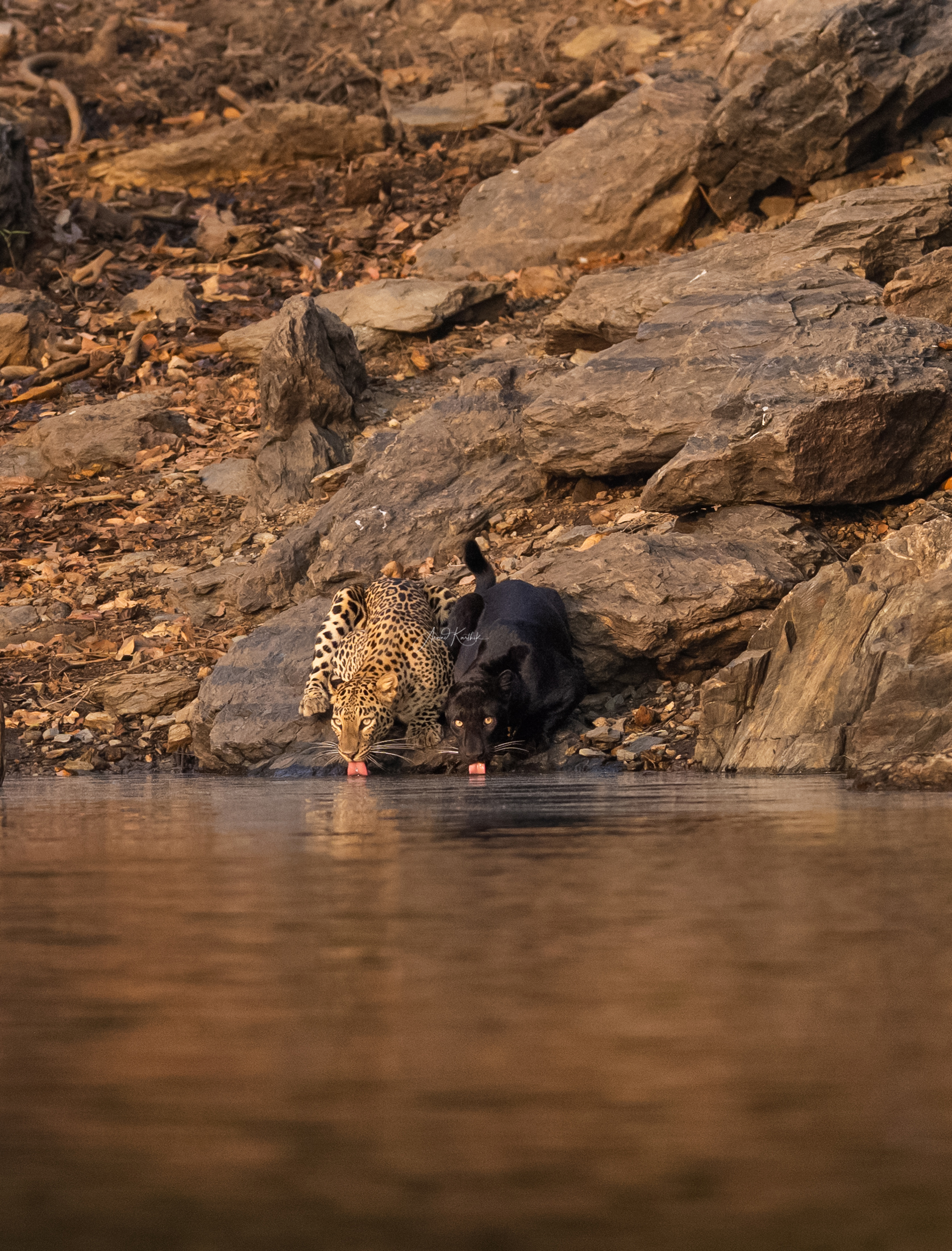
On a Katrivia boat safari at Bhadra Tiger Reserve, a leopardess searching for her cubs led guests to a rare reunion: her two sons, including Bhadra’s famous Black Panther, walking together for nearly three kilometres along the backwaters. The family was moving away from a newly arrived male leopard, a possible threat to the cubs. The safari ended with a now widely shared photograph of mother and son drinking from the water side by side.
Few animals capture the imagination of wildlife enthusiasts quite like a black panther. The combination of rarity, mystery and beauty makes every sighting special. Towards the end of 2025, sightings of Bhadra Tiger Reserve’s famous melanistic leopard began attracting widespread attention among photographers and wildlife lovers alike.
However, behind every successful young predator lies a much bigger story: a story of survival, learning and protection. Behind this Black Panther stood an extraordinary mother who had successfully raised three cubs despite the many challenges that life in the wild presents. Her family consisted of a melanistic male leopard, a normal male leopard and a female cub. Raising even one cub to independence is challenging. Raising three healthy cubs in a landscape filled with competition and uncertainty is a testament to remarkable intelligence and resilience.
Our adventure began in Bangalore, where a group of wildlife enthusiasts assembled for a guided expedition to Bhadra Tiger Reserve with Katrivia Expeditions. Led by wildlife photographer Arvind Karthik, the safari promised an immersive experience in the wild. I, Madhavi Arvind, was delighted to join the group as a member of the Katrivia Expeditions team and be part of this memorable journey.
As we travelled towards Bhadra, conversations revolved around wildlife, photography and the possibility of witnessing some of the reserve’s most iconic residents. The anticipation was high, but none of us could have imagined the remarkable story that was about to unfold.
Before our afternoon safari, we spent some time at the pantry of River Tern Lodge, sipping a cup of coffee while overlooking the beautiful backwaters nearby. The atmosphere was calm, yet one sound repeatedly interrupted the silence. Bonnet macaques (Macaca radiata) were continuously giving alarm calls from the direction of the backwaters. Again and again, the calls echoed through the landscape.
For anyone familiar with wildlife behaviour, alarm calls are often among the most valuable clues in the forest. Animals frequently detect predators long before humans do, and their calls can reveal secrets hidden from our eyes. The macaques sounded genuinely disturbed. Naturally, curiosity took over. What was causing such persistent alarm calls? Was there a leopard nearby? Had a tiger entered the area? Or was something else unfolding beyond our view? At the time, we had no answers. Looking back now, we realise that the forest had already begun revealing the first clues of the extraordinary story that was about to unfold.
At Bhadra, choosing the right safari can often shape the entire experience. After assessing recent wildlife movements and the prevailing conditions, Arvind Karthik, one of the skippers with Katrivia Expeditions, trusted his instincts and recommended a boat safari for the afternoon, a decision that would soon prove to be the right one.
By 3:30 pm, everyone had settled into their seats. Cameras were checked, binoculars were ready, and a sense of anticipation filled the air as the boat slowly drifted away from the shore. The adventure had begun.
Barely ten minutes into the safari, whispers spread through the boat: “Leopard.” Every eye immediately turned towards the shoreline. There she was: a magnificent leopardess walking gracefully along the rocky banks, framed by dense vegetation and towering trees behind her. The setting was breathtaking. The rugged shoreline, the backwaters and the forested backdrop created one of those rare moments where the habitat itself becomes part of the story. For photographers, it was a dream frame.
Yet while everyone admired the sighting, something about her behaviour stood out. She seemed restless. She repeatedly paused, scanned the surroundings and listened carefully before moving forward again.
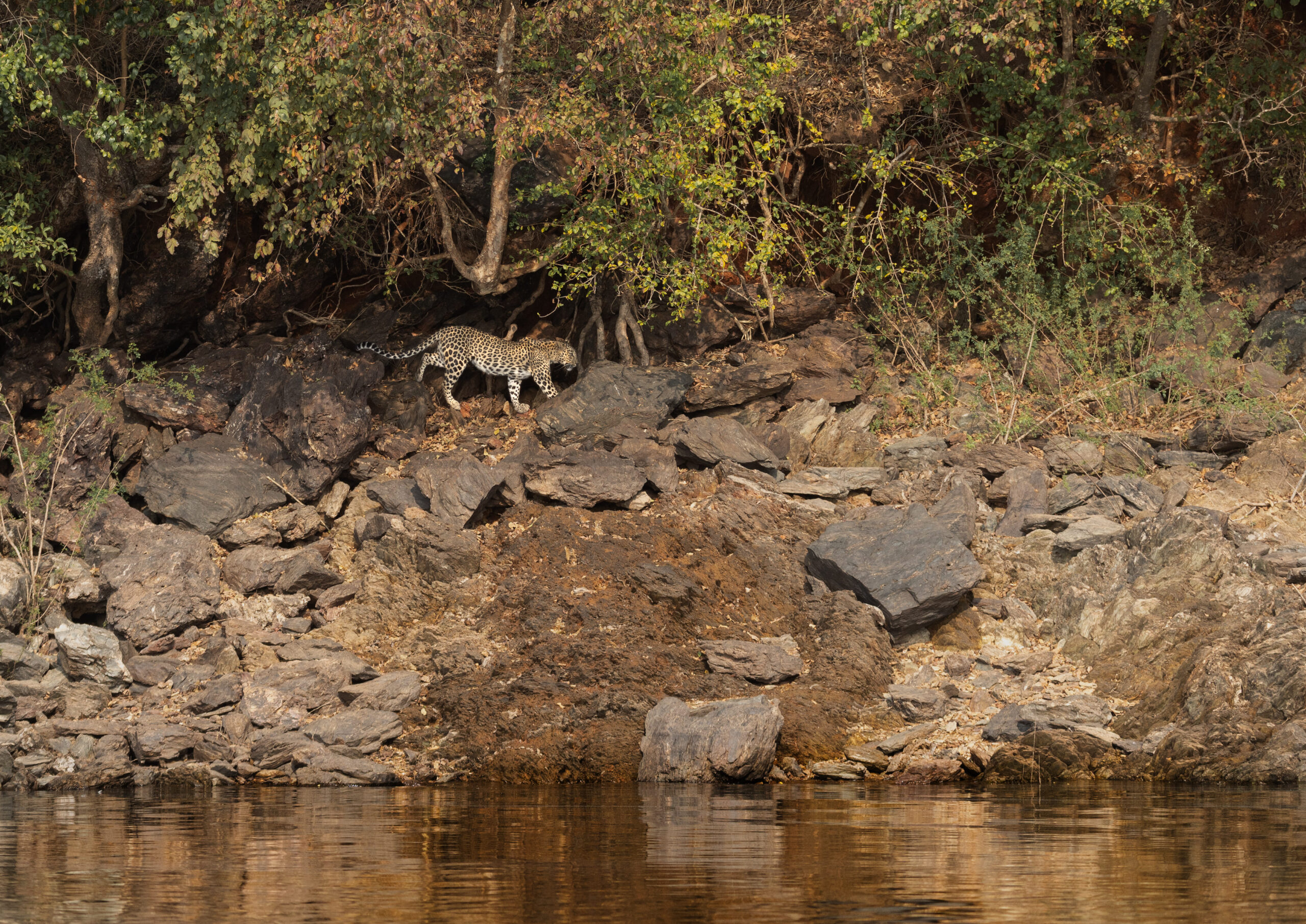
As we continued observing her, it became increasingly clear that she was not simply moving through her territory. She was searching. Every few moments she produced soft sawing calls. There was purpose behind every movement. Recent reports indicated that her cubs had been seen near the shoreline after feeding on a kill the previous day. Suddenly, everything made sense. We were not merely watching a leopard. We were witnessing a mother searching for her young.
Then came the moment that changed everything. Movement appeared behind the vegetation. A young male leopard emerged. Moments later, another figure followed: the famous Black Panther. A collective gasp swept through the boat. Not only had the mother found her cubs, but we were now watching one of India’s most iconic leopards standing alongside his family. For everyone present, it felt almost unreal.
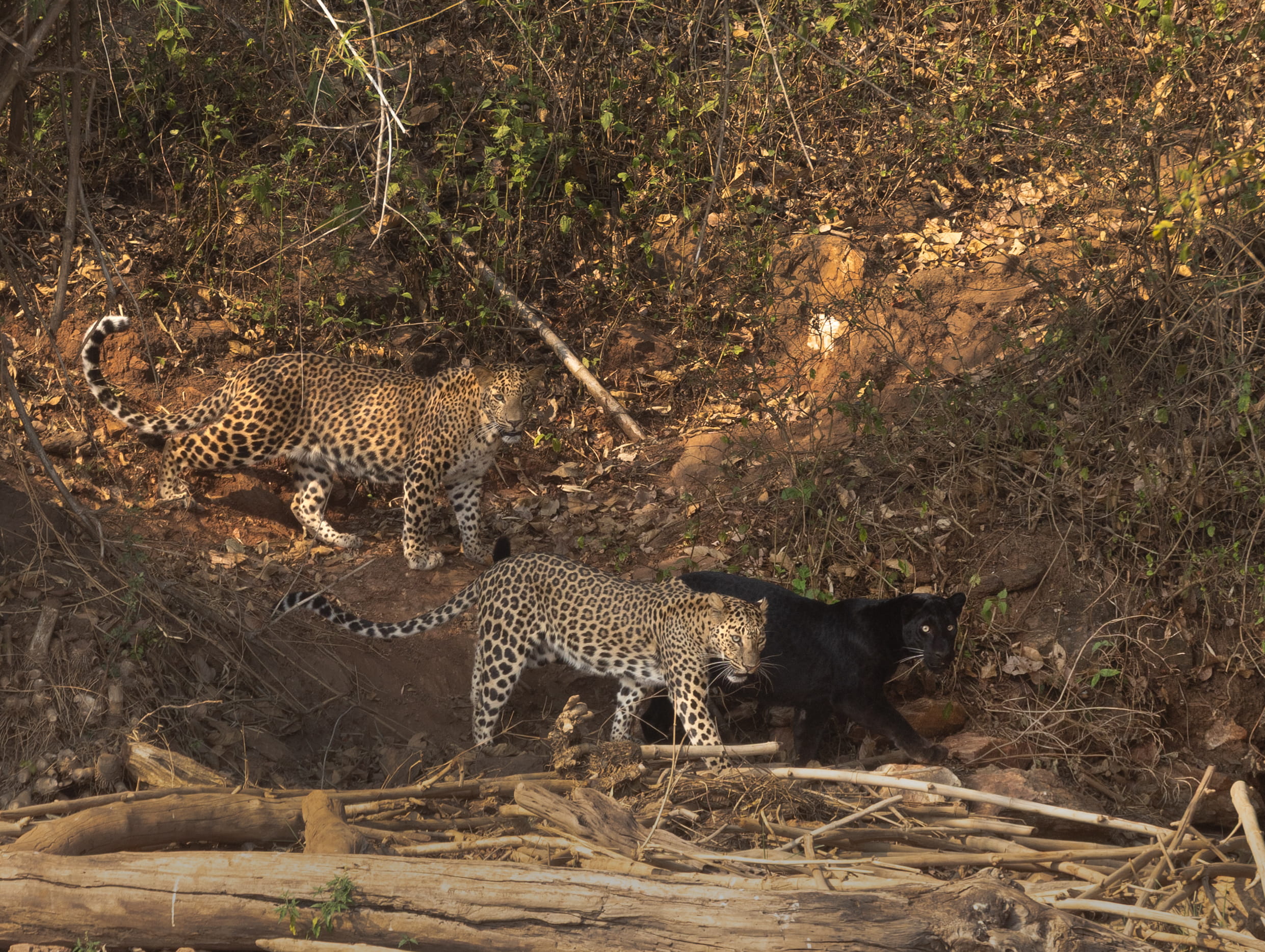
As events unfolded, a clearer picture emerged. A new male leopard had recently entered the area. For a mother leopard raising cubs, an unfamiliar male can represent a significant threat. Suddenly, her anxious behaviour and constant calling made perfect sense. She was gathering her cubs and preparing to move them away from potential danger. What we were witnessing was maternal protection in action.
Having reunited with her sons, the leopardess began moving away from the area. The remains of the previous day’s kill were abandoned. Safety had become the priority. The mother led the way. Her sons followed. Together they began a remarkable journey along the shoreline.
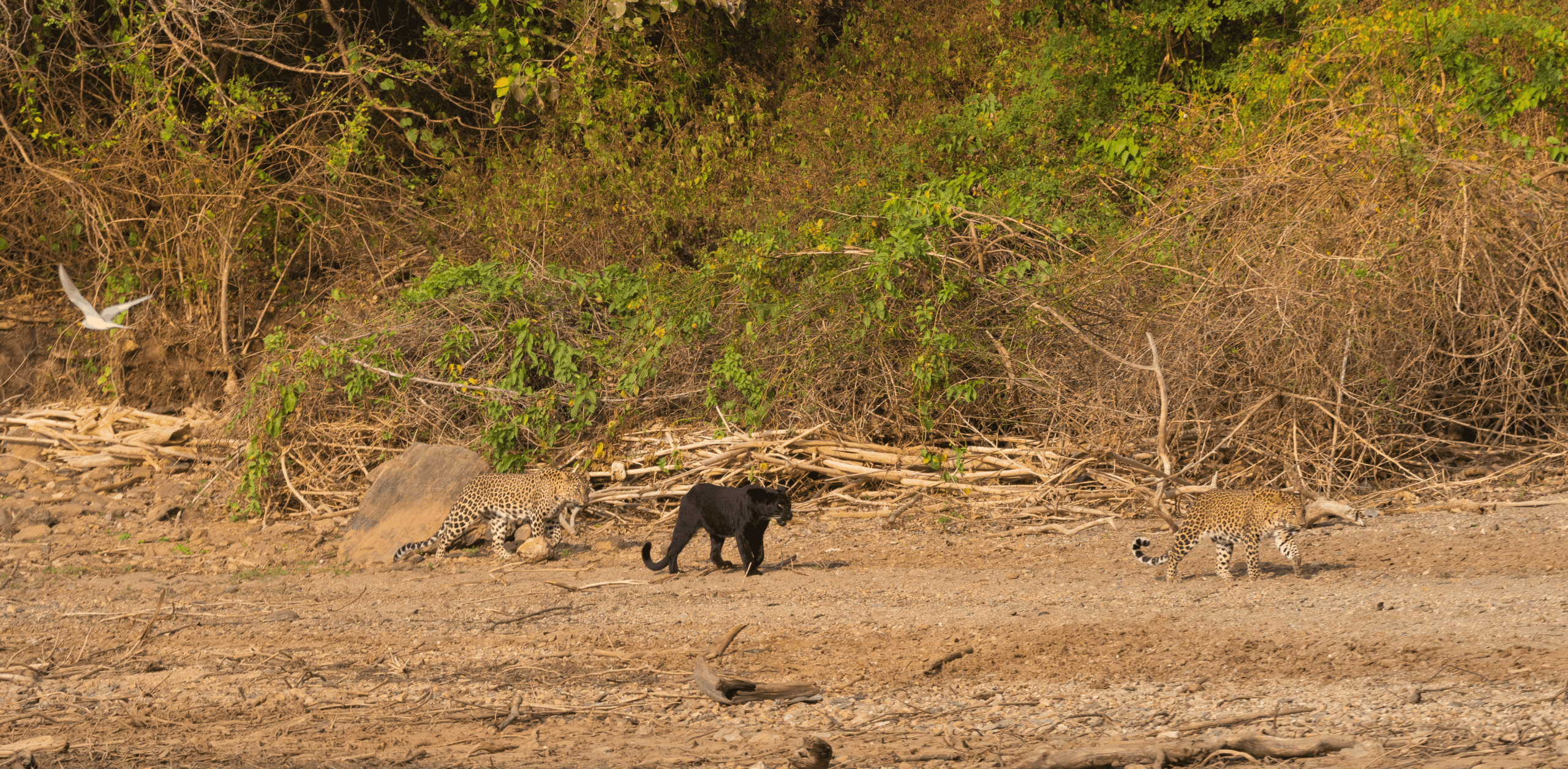
What followed remains one of the most spectacular leopard sightings we have ever witnessed. For nearly three kilometres, the family walked together along the edge of the backwaters. The mother led. The normal-coloured male followed. The Black Panther remained close behind. Every minute felt surreal. The shimmering water on one side and the forests on the other created a breathtaking backdrop for one of nature’s most beautiful family stories.
As the family continued walking, the personalities of the two brothers became increasingly obvious. The Black Panther’s sibling appeared independent and confident. The Black Panther, however, remained deeply attached to his mother. At one point he simply stopped walking and sat down to rest. His mother called repeatedly, encouraging him to continue. Eventually he stood up and followed once again. Watching the interaction was both fascinating and unexpectedly heartwarming.
Throughout the sighting, one thing became increasingly clear: the true hero of the story was the mother. Every action revolved around protecting her cubs. She searched for them. She reunited with them. She guided them. She protected them. In that moment, she reminded us that motherhood transcends species.
By this point, we had witnessed a family reunion, a protective mother leading her cubs to safety, and one of the most remarkable leopard sightings imaginable. Surely, we thought, the surprises were over. We were wrong.
As the leopardess paused to scent-mark a prominent spot along the shoreline, she looked every bit the experienced mother: focused, alert and completely in control. Then, out of nowhere, the Black Panther trotted up behind her and did something none of us expected. He raised his paw and gave her a playful smack. For a moment, everyone on the boat burst into laughter. It was such an unexpected contrast. Here was one of India’s most famous and sought-after black panthers, an animal that had become almost mythical among wildlife photographers, behaving less like a powerful predator and more like a mischievous teenager trying to get his mother’s attention.
The leopardess barely acknowledged his antics and carried on as if this was something she dealt with regularly. That reaction somehow made the moment even funnier. In a sighting filled with drama, emotion and unforgettable behaviour, this brief interaction revealed something different: the personality behind the legend. Beneath the striking black coat was still a playful youngster who had not quite outgrown his mother’s company. And fortunately for us, the entire moment was frozen in a single photograph.
As the golden evening light cast a warm glow across Bhadra’s backwaters, the leopardess finally paused at the water’s edge. For hours we had watched her search tirelessly for her cubs, reunite her family and guide them away from a potential threat. Every step she had taken that afternoon was driven by a mother’s instinct to protect.
Then came a moment that seemed almost too perfect to be real. The Black Panther quietly walked up beside her. Without hesitation, mother and son lowered their heads and drank from the still waters together. The scene lasted only a few seconds, but the emotion it carried was immense. In front of us stood one of India’s most famous black panthers, yet in that moment he was not the elusive predator that photographers dreamt of seeing. He was simply a son beside the mother who had raised, protected and taught him how to survive in the wild.
The entire boat fell silent. Cameras clicked, but nobody spoke. We all sensed that we were witnessing something far more meaningful than a rare sighting. This was a story unfolding before our eyes: a story of family, trust, survival and the extraordinary bond between a mother and her cub.
At that precise instant, Arvind Karthik captured a photograph that would soon travel far beyond the forests of Bhadra. The image created a sensation among wildlife enthusiasts and photographers, quickly becoming one of the most widely shared photographs associated with Bhadra’s Black Panther. What made it so powerful was not just the presence of a melanistic leopard, but the emotion behind it. More than a photograph, it became a symbol of motherhood in the wild, a once-in-a-lifetime moment that reminded us that behind every great predator is a story, and behind this Black Panther stood an extraordinary mother.
As the safari continued, another subtle detail became apparent. The sibling increasingly maintained a greater distance from his mother. He appeared ready to begin his independent journey. The Black Panther, however, remained close. He walked beside her. Rested near her. Drank alongside her. It felt as though we were witnessing two different stages of life unfolding simultaneously: one sibling preparing to leave, the other not quite ready.
What made this encounter unforgettable was not simply the presence of a Black Panther. It was the story: a mother searching for her cubs, a family reunion, a hidden threat, three leopards walking together for kilometres, sibling rivalry, maternal protection, and a bond between mother and son that was impossible to ignore. These are the moments that transform a wildlife sighting into a lifelong memory.
Experiences like these demonstrate why a Bhadra Tiger Reserve Safari remains one of the most rewarding wildlife experiences in India. The reserve’s forests, grasslands, rocky landscapes and beautiful backwaters create exceptional opportunities for observing wildlife behaviour. For photographers wondering about the best time for wildlife photography, Bhadra consistently rewards patience and observation, particularly during the dry months when wildlife activity around water bodies becomes easier to observe. Every safari offers a new possibility. Every shoreline may reveal a new story.
No. A black panther is not a separate species. It is the melanistic colour form of the leopard (Panthera pardus) or, in the Americas, the jaguar. Melanism in leopards is caused by a recessive gene, so two normal-coloured leopards can produce a black cub if both carry the gene, and the leopard’s usual rosette pattern is still faintly visible under the extra black pigment.
Bhadra Tiger Reserve became known towards the end of 2025 for regular sightings of a melanistic leopard, often photographed with his mother and brother along the backwaters. Sightings are never guaranteed on any safari, but Bhadra’s mix of forest, grassland and backwater habitat has made it one of the more consistent places in India to look for one.
Bhadra consistently rewards patience and observation, particularly during the drier months when wildlife activity around water bodies becomes easier to observe. Karnataka Tourism lists October to March as the typical best season; conditions vary by year, so check current safari availability before you book.
Bhadra’s backwaters allow guided boat safaris in addition to jeep safaris, run through River Tern Lodge in coordination with the forest department. Boat safaris follow the shoreline and reservoir, which is how this particular leopard family sighting unfolded.
Bonnet macaques (Macaca radiata) and other animals give alarm calls when they detect a potential predator nearby, often before human observers can see anything. Experienced guides listen for these calls as one of the most reliable clues to a leopard or tiger’s presence in the area.
Yes. An unfamiliar male entering a female leopard’s territory can pose a real risk to cubs, so mothers often move their young away from an area when a new male is detected. The protective, anxious behaviour described in this story is a recognised pattern in leopard behaviour, not unique to this sighting.
Litters are typically two to three cubs, but survival to independence is far from guaranteed given predation, competition and other risks in the wild. Raising three cubs to near-independence, as described in this story, is considered a significant achievement for a wild leopardess.
You can book a Bhadra Tiger Reserve tour with Katrivia Expeditions, which includes the boat and jeep safaris where this leopard family has been seen. No specific sighting can ever be guaranteed, but Katrivia’s skippers plan each safari around recent wildlife movement and conditions.
Bhadra is home to tigers, elephants, gaur, sloth bears and otters, and its backwaters draw River Terns, ospreys and grey-headed fish eagles. The reserve’s mix of forest, grassland and water habitat supports a wide range of sightings beyond any single animal.
Madhavi Arvind is part of the team at Katrivia Expeditions, a wildlife travel company that curates guided wildlife safaris, photography expeditions and immersive nature experiences across India and select international destinations. She writes about wildlife behaviour and field experiences from Katrivia’s tours.
The photograph was captured by Arvind Karthik, wildlife photographer and founder of Katrivia Expeditions, during the same afternoon safari described in this story.
This sighting unfolded gradually over roughly three kilometres and several hours, so patience and staying with the animals mattered more than any single technique. A telephoto zoom that lets you move between wider habitat shots and closer portraits, such as the one covered in our Canon RF 100-300mm F2.8 review, suits this kind of unfolding, habitat-led story.
At Katrivia Expeditions, we believe the finest wildlife tours in India are not measured solely by the number of animals seen. They are measured by the stories experienced. This unforgettable encounter with Bhadra’s Black Panther family remains one of the most remarkable moments we have ever shared with our guests. If you are looking to book a wildlife safari and experience nature in its purest form, Bhadra Tiger Reserve continues to be one of our most recommended destinations. Because sometimes the wild gives you a sighting. And sometimes, if you are fortunate enough, it gives you a story that stays with you forever.
What made this encounter unforgettable was not just the sight of Bhadra’s famous Black Panther, but the story that unfolded around him. Watching a mother reunite with her cubs, guide them through uncertainty and protect them from potential danger offered a rare glimpse into the emotional and behavioural complexity of wild leopards. Some sightings are memorable. Others become stories that stay with you forever.
At Katrivia Expeditions, we believe wildlife travel is about more than just sightings: it is about understanding behaviour, appreciating nature and experiencing the stories that unfold in the wild. We organise guided wildlife tours, photography expeditions and nature-based experiences across India and international destinations, offering travellers an opportunity to connect with some of the world’s most extraordinary wilderness landscapes.
Website: www.katrivia.com · Phone: +91 96208 08727 · Instagram: @katrivia_wild
Join us on a future safari and create your own unforgettable wildlife story.
Madhavi Arvind is part of the team at Katrivia Expeditions, a wildlife travel company that curates guided wildlife safaris, photography expeditions and immersive nature experiences across India and select international destinations, including Africa. Passionate about wildlife, photography and conservation, she enjoys sharing meaningful wilderness experiences and stories from the wild with fellow nature enthusiasts. Follow along on Instagram.
This is a first-person field account. The sighting, behaviour and sequence of events described are the author’s own observation on a single safari, not a guaranteed pattern for future visits. Confirm current safari options, timings and availability with Katrivia Expeditions or the forest department before you travel.